Review


Structured Review

GeneTex primary antibody against leptin
Primary Antibody Against Leptin, supplied by GeneTex, used in various techniques. Bioz Stars score: 90/100, based on 1 PubMed citations. ZERO BIAS - scores, article reviews, protocol conditions and more
https://www.bioz.com/result/primary antibody against leptin/product/GeneTex
Average 90 stars, based on 1 article reviews
primary antibody against leptin - by Bioz Stars, 2026-03
90/100 stars

Images


Similar Products

90
Bioss primary antibodies against leptin receptor
Primary Antibodies Against Leptin Receptor, supplied by Bioss, used in various techniques. Bioz Stars score: 90/100, based on 1 PubMed citations. ZERO BIAS - scores, article reviews, protocol conditions and more
https://www.bioz.com/result/primary antibodies against leptin receptor/product/Bioss
Average 90 stars, based on 1 article reviews
primary antibodies against leptin receptor - by Bioz Stars, 2026-03
90/100 stars
  Buy from Supplier

94
R&D Systems primary antibody against leptin
Primary Antibody Against Leptin, supplied by R&D Systems, used in various techniques. Bioz Stars score: 94/100, based on 1 PubMed citations. ZERO BIAS - scores, article reviews, protocol conditions and more
https://www.bioz.com/result/primary antibody against leptin/product/R&D Systems
Average 94 stars, based on 1 article reviews
primary antibody against leptin - by Bioz Stars, 2026-03
94/100 stars
  Buy from Supplier

93
Santa Cruz Biotechnology primary antibodies against leptin receptor
Primary Antibodies Against Leptin Receptor, supplied by Santa Cruz Biotechnology, used in various techniques. Bioz Stars score: 93/100, based on 1 PubMed citations. ZERO BIAS - scores, article reviews, protocol conditions and more
https://www.bioz.com/result/primary antibodies against leptin receptor/product/Santa Cruz Biotechnology
Average 93 stars, based on 1 article reviews
primary antibodies against leptin receptor - by Bioz Stars, 2026-03
93/100 stars
  Buy from Supplier

90
Thermo Fisher primary antibodies against leptin receptor
Body weight (n = 13 <t>for</t> <t>LRP1</t> loxP/loxP , n = 11 for Foxj1-Cre; LRP1 loxP/loxP ), (b) body mass (n = 13 for LRP1 loxP/loxP , n = 11 for Foxj1-Cre; LRP1 loxP/loxP ), and (c) fat weight (n = 10 per group) were measured in male LRP1 loxP/loxP and Foxj1-Cre; LRP1 loxP/loxP mice. (d) Body weight (n = 12 for LRP1 loxP/loxP , n = 13 for Foxj1-Cre; LRP1 loxP/loxP ), (e) body mass (n = 12 for LRP1 loxP/loxP , n = 13 for Foxj1-Cre; LRP1 loxP/loxP ), and (f) fat weight (n = 9 per group) were measured in female LRP1 loxP/loxP and Foxj1-Cre; LRP1 loxP/loxP mice. (g) Daily food intake (n = 8 for LRP1 loxP/loxP , n = 9 for Foxj1-Cre; LRP1 loxP/loxP ), (h) serum <t>leptin</t> (n = 8 for LRP1 loxP/loxP , n = 6 for Foxj1-Cre; LRP1 loxP/loxP ), (i) blood glucose (n = 9 per group), (j) serum insulin (n = 8 for LRP1 loxP/loxP , n = 6 for Foxj1-Cre; LRP1 loxP/loxP ), and (k) serum FFA (n = 8 for LRP1 loxP/loxP , n = 6 for Foxj1-Cre; LRP1 loxP/loxP ) were measured in male LRP1 loxP/loxP and Foxj1-Cre; LRP1 loxP/loxP mice. (l) Daily food intake (n = 7 for LRP1 loxP/loxP , n = 6 for Foxj1-Cre; LRP1 loxP/loxP ), (m) serum leptin (n = 10/group), (n) blood glucose (n = 10 per group), (o) serum insulin (n = 10 per group), and (p) serum FFA (n = 10 per group) were measured in female LRP1 loxP/loxP and Foxj1-Cre; LRP1 loxP/loxP mice. (r) Glucose tolerance test (GTT) (n = 6 for LRP1 loxP/loxP , n = 8 for Foxj1-Cre; LRP1 loxP/loxP ) and (s) insulin tolerance test (ITT) (n = 7 for LRP1 loxP/loxP , n = 9 for Foxj1-Cre; LRP1 loxP/loxP ) were performed in male LRP1 loxP/loxP and Foxj1-Cre; LRP1 loxP/loxP mice at 18–20 weeks of age. (t) Glucose tolerance test (GTT) (n = 6) and (u) insulin tolerance test (ITT) (n = 7 for LRP1 loxP/loxP , n = 5 for Foxj1-Cre; LRP1 loxP/loxP ) were performed in female LRP1 loxP/loxP and Foxj1-Cre; LRP1 loxP/loxP mice at 30–32 weeks of age. Serum parameters, body mass, and fat weight were measured at 24 weeks of age for male mice and at 32 weeks of age for female mice. Daily food intake were measured at 18 weeks of age for male mice and at 32 weeks of age for female mice. Serum parameters were measured from overnight fasted mice. All bars and errors represent means ± SEM. p values by repeated measures two-way ANOVA in a, d, g, I, r–t, and u and by two-sided student t -test in b, c, e, f, h–k, and m–p are indicated. * P < 0.05, ** P < 0.01, and *** P < 0.001 vs. LRP1 loxP/loxP mice.
Primary Antibodies Against Leptin Receptor, supplied by Thermo Fisher, used in various techniques. Bioz Stars score: 90/100, based on 1 PubMed citations. ZERO BIAS - scores, article reviews, protocol conditions and more
https://www.bioz.com/result/primary antibodies against leptin receptor/product/Thermo Fisher
Average 90 stars, based on 1 article reviews
primary antibodies against leptin receptor - by Bioz Stars, 2026-03
90/100 stars
  Buy from Supplier

90
GeneTex primary antibody against leptin
Body weight (n = 13 <t>for</t> <t>LRP1</t> loxP/loxP , n = 11 for Foxj1-Cre; LRP1 loxP/loxP ), (b) body mass (n = 13 for LRP1 loxP/loxP , n = 11 for Foxj1-Cre; LRP1 loxP/loxP ), and (c) fat weight (n = 10 per group) were measured in male LRP1 loxP/loxP and Foxj1-Cre; LRP1 loxP/loxP mice. (d) Body weight (n = 12 for LRP1 loxP/loxP , n = 13 for Foxj1-Cre; LRP1 loxP/loxP ), (e) body mass (n = 12 for LRP1 loxP/loxP , n = 13 for Foxj1-Cre; LRP1 loxP/loxP ), and (f) fat weight (n = 9 per group) were measured in female LRP1 loxP/loxP and Foxj1-Cre; LRP1 loxP/loxP mice. (g) Daily food intake (n = 8 for LRP1 loxP/loxP , n = 9 for Foxj1-Cre; LRP1 loxP/loxP ), (h) serum <t>leptin</t> (n = 8 for LRP1 loxP/loxP , n = 6 for Foxj1-Cre; LRP1 loxP/loxP ), (i) blood glucose (n = 9 per group), (j) serum insulin (n = 8 for LRP1 loxP/loxP , n = 6 for Foxj1-Cre; LRP1 loxP/loxP ), and (k) serum FFA (n = 8 for LRP1 loxP/loxP , n = 6 for Foxj1-Cre; LRP1 loxP/loxP ) were measured in male LRP1 loxP/loxP and Foxj1-Cre; LRP1 loxP/loxP mice. (l) Daily food intake (n = 7 for LRP1 loxP/loxP , n = 6 for Foxj1-Cre; LRP1 loxP/loxP ), (m) serum leptin (n = 10/group), (n) blood glucose (n = 10 per group), (o) serum insulin (n = 10 per group), and (p) serum FFA (n = 10 per group) were measured in female LRP1 loxP/loxP and Foxj1-Cre; LRP1 loxP/loxP mice. (r) Glucose tolerance test (GTT) (n = 6 for LRP1 loxP/loxP , n = 8 for Foxj1-Cre; LRP1 loxP/loxP ) and (s) insulin tolerance test (ITT) (n = 7 for LRP1 loxP/loxP , n = 9 for Foxj1-Cre; LRP1 loxP/loxP ) were performed in male LRP1 loxP/loxP and Foxj1-Cre; LRP1 loxP/loxP mice at 18–20 weeks of age. (t) Glucose tolerance test (GTT) (n = 6) and (u) insulin tolerance test (ITT) (n = 7 for LRP1 loxP/loxP , n = 5 for Foxj1-Cre; LRP1 loxP/loxP ) were performed in female LRP1 loxP/loxP and Foxj1-Cre; LRP1 loxP/loxP mice at 30–32 weeks of age. Serum parameters, body mass, and fat weight were measured at 24 weeks of age for male mice and at 32 weeks of age for female mice. Daily food intake were measured at 18 weeks of age for male mice and at 32 weeks of age for female mice. Serum parameters were measured from overnight fasted mice. All bars and errors represent means ± SEM. p values by repeated measures two-way ANOVA in a, d, g, I, r–t, and u and by two-sided student t -test in b, c, e, f, h–k, and m–p are indicated. * P < 0.05, ** P < 0.01, and *** P < 0.001 vs. LRP1 loxP/loxP mice.
Primary Antibody Against Leptin, supplied by GeneTex, used in various techniques. Bioz Stars score: 90/100, based on 1 PubMed citations. ZERO BIAS - scores, article reviews, protocol conditions and more
https://www.bioz.com/result/primary antibody against leptin/product/GeneTex
Average 90 stars, based on 1 article reviews
primary antibody against leptin - by Bioz Stars, 2026-03
90/100 stars
  Buy from Supplier

95
Santa Cruz Biotechnology primary antibodies against leptin
Body weight (n = 13 <t>for</t> <t>LRP1</t> loxP/loxP , n = 11 for Foxj1-Cre; LRP1 loxP/loxP ), (b) body mass (n = 13 for LRP1 loxP/loxP , n = 11 for Foxj1-Cre; LRP1 loxP/loxP ), and (c) fat weight (n = 10 per group) were measured in male LRP1 loxP/loxP and Foxj1-Cre; LRP1 loxP/loxP mice. (d) Body weight (n = 12 for LRP1 loxP/loxP , n = 13 for Foxj1-Cre; LRP1 loxP/loxP ), (e) body mass (n = 12 for LRP1 loxP/loxP , n = 13 for Foxj1-Cre; LRP1 loxP/loxP ), and (f) fat weight (n = 9 per group) were measured in female LRP1 loxP/loxP and Foxj1-Cre; LRP1 loxP/loxP mice. (g) Daily food intake (n = 8 for LRP1 loxP/loxP , n = 9 for Foxj1-Cre; LRP1 loxP/loxP ), (h) serum <t>leptin</t> (n = 8 for LRP1 loxP/loxP , n = 6 for Foxj1-Cre; LRP1 loxP/loxP ), (i) blood glucose (n = 9 per group), (j) serum insulin (n = 8 for LRP1 loxP/loxP , n = 6 for Foxj1-Cre; LRP1 loxP/loxP ), and (k) serum FFA (n = 8 for LRP1 loxP/loxP , n = 6 for Foxj1-Cre; LRP1 loxP/loxP ) were measured in male LRP1 loxP/loxP and Foxj1-Cre; LRP1 loxP/loxP mice. (l) Daily food intake (n = 7 for LRP1 loxP/loxP , n = 6 for Foxj1-Cre; LRP1 loxP/loxP ), (m) serum leptin (n = 10/group), (n) blood glucose (n = 10 per group), (o) serum insulin (n = 10 per group), and (p) serum FFA (n = 10 per group) were measured in female LRP1 loxP/loxP and Foxj1-Cre; LRP1 loxP/loxP mice. (r) Glucose tolerance test (GTT) (n = 6 for LRP1 loxP/loxP , n = 8 for Foxj1-Cre; LRP1 loxP/loxP ) and (s) insulin tolerance test (ITT) (n = 7 for LRP1 loxP/loxP , n = 9 for Foxj1-Cre; LRP1 loxP/loxP ) were performed in male LRP1 loxP/loxP and Foxj1-Cre; LRP1 loxP/loxP mice at 18–20 weeks of age. (t) Glucose tolerance test (GTT) (n = 6) and (u) insulin tolerance test (ITT) (n = 7 for LRP1 loxP/loxP , n = 5 for Foxj1-Cre; LRP1 loxP/loxP ) were performed in female LRP1 loxP/loxP and Foxj1-Cre; LRP1 loxP/loxP mice at 30–32 weeks of age. Serum parameters, body mass, and fat weight were measured at 24 weeks of age for male mice and at 32 weeks of age for female mice. Daily food intake were measured at 18 weeks of age for male mice and at 32 weeks of age for female mice. Serum parameters were measured from overnight fasted mice. All bars and errors represent means ± SEM. p values by repeated measures two-way ANOVA in a, d, g, I, r–t, and u and by two-sided student t -test in b, c, e, f, h–k, and m–p are indicated. * P < 0.05, ** P < 0.01, and *** P < 0.001 vs. LRP1 loxP/loxP mice.
Primary Antibodies Against Leptin, supplied by Santa Cruz Biotechnology, used in various techniques. Bioz Stars score: 95/100, based on 1 PubMed citations. ZERO BIAS - scores, article reviews, protocol conditions and more
https://www.bioz.com/result/primary antibodies against leptin/product/Santa Cruz Biotechnology
Average 95 stars, based on 1 article reviews
primary antibodies against leptin - by Bioz Stars, 2026-03
95/100 stars
  Buy from Supplier

90
Santa Cruz Biotechnology primary antibody against leptin- a ob (a- 20): sc- 842
Body weight (n = 13 <t>for</t> <t>LRP1</t> loxP/loxP , n = 11 for Foxj1-Cre; LRP1 loxP/loxP ), (b) body mass (n = 13 for LRP1 loxP/loxP , n = 11 for Foxj1-Cre; LRP1 loxP/loxP ), and (c) fat weight (n = 10 per group) were measured in male LRP1 loxP/loxP and Foxj1-Cre; LRP1 loxP/loxP mice. (d) Body weight (n = 12 for LRP1 loxP/loxP , n = 13 for Foxj1-Cre; LRP1 loxP/loxP ), (e) body mass (n = 12 for LRP1 loxP/loxP , n = 13 for Foxj1-Cre; LRP1 loxP/loxP ), and (f) fat weight (n = 9 per group) were measured in female LRP1 loxP/loxP and Foxj1-Cre; LRP1 loxP/loxP mice. (g) Daily food intake (n = 8 for LRP1 loxP/loxP , n = 9 for Foxj1-Cre; LRP1 loxP/loxP ), (h) serum <t>leptin</t> (n = 8 for LRP1 loxP/loxP , n = 6 for Foxj1-Cre; LRP1 loxP/loxP ), (i) blood glucose (n = 9 per group), (j) serum insulin (n = 8 for LRP1 loxP/loxP , n = 6 for Foxj1-Cre; LRP1 loxP/loxP ), and (k) serum FFA (n = 8 for LRP1 loxP/loxP , n = 6 for Foxj1-Cre; LRP1 loxP/loxP ) were measured in male LRP1 loxP/loxP and Foxj1-Cre; LRP1 loxP/loxP mice. (l) Daily food intake (n = 7 for LRP1 loxP/loxP , n = 6 for Foxj1-Cre; LRP1 loxP/loxP ), (m) serum leptin (n = 10/group), (n) blood glucose (n = 10 per group), (o) serum insulin (n = 10 per group), and (p) serum FFA (n = 10 per group) were measured in female LRP1 loxP/loxP and Foxj1-Cre; LRP1 loxP/loxP mice. (r) Glucose tolerance test (GTT) (n = 6 for LRP1 loxP/loxP , n = 8 for Foxj1-Cre; LRP1 loxP/loxP ) and (s) insulin tolerance test (ITT) (n = 7 for LRP1 loxP/loxP , n = 9 for Foxj1-Cre; LRP1 loxP/loxP ) were performed in male LRP1 loxP/loxP and Foxj1-Cre; LRP1 loxP/loxP mice at 18–20 weeks of age. (t) Glucose tolerance test (GTT) (n = 6) and (u) insulin tolerance test (ITT) (n = 7 for LRP1 loxP/loxP , n = 5 for Foxj1-Cre; LRP1 loxP/loxP ) were performed in female LRP1 loxP/loxP and Foxj1-Cre; LRP1 loxP/loxP mice at 30–32 weeks of age. Serum parameters, body mass, and fat weight were measured at 24 weeks of age for male mice and at 32 weeks of age for female mice. Daily food intake were measured at 18 weeks of age for male mice and at 32 weeks of age for female mice. Serum parameters were measured from overnight fasted mice. All bars and errors represent means ± SEM. p values by repeated measures two-way ANOVA in a, d, g, I, r–t, and u and by two-sided student t -test in b, c, e, f, h–k, and m–p are indicated. * P < 0.05, ** P < 0.01, and *** P < 0.001 vs. LRP1 loxP/loxP mice.
Primary Antibody Against Leptin A Ob (A 20): Sc 842, supplied by Santa Cruz Biotechnology, used in various techniques. Bioz Stars score: 90/100, based on 1 PubMed citations. ZERO BIAS - scores, article reviews, protocol conditions and more
https://www.bioz.com/result/primary antibody against leptin- a ob (a- 20): sc- 842/product/Santa Cruz Biotechnology
Average 90 stars, based on 1 article reviews
primary antibody against leptin- a ob (a- 20): sc- 842 - by Bioz Stars, 2026-03
90/100 stars
  Buy from Supplier

Image Search Results


Body weight (n = 13 for LRP1 loxP/loxP , n = 11 for Foxj1-Cre; LRP1 loxP/loxP ), (b) body mass (n = 13 for LRP1 loxP/loxP , n = 11 for Foxj1-Cre; LRP1 loxP/loxP ), and (c) fat weight (n = 10 per group) were measured in male LRP1 loxP/loxP and Foxj1-Cre; LRP1 loxP/loxP mice. (d) Body weight (n = 12 for LRP1 loxP/loxP , n = 13 for Foxj1-Cre; LRP1 loxP/loxP ), (e) body mass (n = 12 for LRP1 loxP/loxP , n = 13 for Foxj1-Cre; LRP1 loxP/loxP ), and (f) fat weight (n = 9 per group) were measured in female LRP1 loxP/loxP and Foxj1-Cre; LRP1 loxP/loxP mice. (g) Daily food intake (n = 8 for LRP1 loxP/loxP , n = 9 for Foxj1-Cre; LRP1 loxP/loxP ), (h) serum leptin (n = 8 for LRP1 loxP/loxP , n = 6 for Foxj1-Cre; LRP1 loxP/loxP ), (i) blood glucose (n = 9 per group), (j) serum insulin (n = 8 for LRP1 loxP/loxP , n = 6 for Foxj1-Cre; LRP1 loxP/loxP ), and (k) serum FFA (n = 8 for LRP1 loxP/loxP , n = 6 for Foxj1-Cre; LRP1 loxP/loxP ) were measured in male LRP1 loxP/loxP and Foxj1-Cre; LRP1 loxP/loxP mice. (l) Daily food intake (n = 7 for LRP1 loxP/loxP , n = 6 for Foxj1-Cre; LRP1 loxP/loxP ), (m) serum leptin (n = 10/group), (n) blood glucose (n = 10 per group), (o) serum insulin (n = 10 per group), and (p) serum FFA (n = 10 per group) were measured in female LRP1 loxP/loxP and Foxj1-Cre; LRP1 loxP/loxP mice. (r) Glucose tolerance test (GTT) (n = 6 for LRP1 loxP/loxP , n = 8 for Foxj1-Cre; LRP1 loxP/loxP ) and (s) insulin tolerance test (ITT) (n = 7 for LRP1 loxP/loxP , n = 9 for Foxj1-Cre; LRP1 loxP/loxP ) were performed in male LRP1 loxP/loxP and Foxj1-Cre; LRP1 loxP/loxP mice at 18–20 weeks of age. (t) Glucose tolerance test (GTT) (n = 6) and (u) insulin tolerance test (ITT) (n = 7 for LRP1 loxP/loxP , n = 5 for Foxj1-Cre; LRP1 loxP/loxP ) were performed in female LRP1 loxP/loxP and Foxj1-Cre; LRP1 loxP/loxP mice at 30–32 weeks of age. Serum parameters, body mass, and fat weight were measured at 24 weeks of age for male mice and at 32 weeks of age for female mice. Daily food intake were measured at 18 weeks of age for male mice and at 32 weeks of age for female mice. Serum parameters were measured from overnight fasted mice. All bars and errors represent means ± SEM. p values by repeated measures two-way ANOVA in a, d, g, I, r–t, and u and by two-sided student t -test in b, c, e, f, h–k, and m–p are indicated. * P < 0.05, ** P < 0.01, and *** P < 0.001 vs. LRP1 loxP/loxP mice.

Journal: bioRxiv

Article Title: LRP1 mediates leptin transport by coupling with the short-form leptin receptor in the choroid plexus

doi: 10.1101/2023.07.03.547520

Figure Lengend Snippet: Body weight (n = 13 for LRP1 loxP/loxP , n = 11 for Foxj1-Cre; LRP1 loxP/loxP ), (b) body mass (n = 13 for LRP1 loxP/loxP , n = 11 for Foxj1-Cre; LRP1 loxP/loxP ), and (c) fat weight (n = 10 per group) were measured in male LRP1 loxP/loxP and Foxj1-Cre; LRP1 loxP/loxP mice. (d) Body weight (n = 12 for LRP1 loxP/loxP , n = 13 for Foxj1-Cre; LRP1 loxP/loxP ), (e) body mass (n = 12 for LRP1 loxP/loxP , n = 13 for Foxj1-Cre; LRP1 loxP/loxP ), and (f) fat weight (n = 9 per group) were measured in female LRP1 loxP/loxP and Foxj1-Cre; LRP1 loxP/loxP mice. (g) Daily food intake (n = 8 for LRP1 loxP/loxP , n = 9 for Foxj1-Cre; LRP1 loxP/loxP ), (h) serum leptin (n = 8 for LRP1 loxP/loxP , n = 6 for Foxj1-Cre; LRP1 loxP/loxP ), (i) blood glucose (n = 9 per group), (j) serum insulin (n = 8 for LRP1 loxP/loxP , n = 6 for Foxj1-Cre; LRP1 loxP/loxP ), and (k) serum FFA (n = 8 for LRP1 loxP/loxP , n = 6 for Foxj1-Cre; LRP1 loxP/loxP ) were measured in male LRP1 loxP/loxP and Foxj1-Cre; LRP1 loxP/loxP mice. (l) Daily food intake (n = 7 for LRP1 loxP/loxP , n = 6 for Foxj1-Cre; LRP1 loxP/loxP ), (m) serum leptin (n = 10/group), (n) blood glucose (n = 10 per group), (o) serum insulin (n = 10 per group), and (p) serum FFA (n = 10 per group) were measured in female LRP1 loxP/loxP and Foxj1-Cre; LRP1 loxP/loxP mice. (r) Glucose tolerance test (GTT) (n = 6 for LRP1 loxP/loxP , n = 8 for Foxj1-Cre; LRP1 loxP/loxP ) and (s) insulin tolerance test (ITT) (n = 7 for LRP1 loxP/loxP , n = 9 for Foxj1-Cre; LRP1 loxP/loxP ) were performed in male LRP1 loxP/loxP and Foxj1-Cre; LRP1 loxP/loxP mice at 18–20 weeks of age. (t) Glucose tolerance test (GTT) (n = 6) and (u) insulin tolerance test (ITT) (n = 7 for LRP1 loxP/loxP , n = 5 for Foxj1-Cre; LRP1 loxP/loxP ) were performed in female LRP1 loxP/loxP and Foxj1-Cre; LRP1 loxP/loxP mice at 30–32 weeks of age. Serum parameters, body mass, and fat weight were measured at 24 weeks of age for male mice and at 32 weeks of age for female mice. Daily food intake were measured at 18 weeks of age for male mice and at 32 weeks of age for female mice. Serum parameters were measured from overnight fasted mice. All bars and errors represent means ± SEM. p values by repeated measures two-way ANOVA in a, d, g, I, r–t, and u and by two-sided student t -test in b, c, e, f, h–k, and m–p are indicated. * P < 0.05, ** P < 0.01, and *** P < 0.001 vs. LRP1 loxP/loxP mice.

Article Snippet: Cells were incubated with primary antibodies against leptin (Cat#: PA5-47023, Thermo Fisher Scientific), LRP1 (Cat#: 37-3800, Thermo Fisher Scientific), or leptin receptor (Cat#: PA1-053, Thermo Fisher Scientific) overnight at 4°C.

Techniques:

Deletion of LRP2 from the choroid plexus (ChP) does not affect body weight and leptin-induced food intake. (a) Genotyping, (b) RNAscope, (c) body weight, (d) body mass, (e) blood glucose, (f) leptin-induced food intake, and (g) pSTAT3 in LRP2 loxP/loxP and Foxj1-Cre; LRP2 loxP/loxP male mice. Body mass was measured by an MRI at 20 weeks of age. Glucose levels were measured from overnight fasted mice at 26 weeks of age. Leptin-induced food intake was measured at 24 weeks of age. pStat3-positive neurons were detected by IHC analysis. All bars and errors represent means ± SEM. * P < 0.05 and ** P < 0.01 vs. LRP1 loxP/loxP mice by repeated measures two-way ANOVA.

Journal: bioRxiv

Article Title: LRP1 mediates leptin transport by coupling with the short-form leptin receptor in the choroid plexus

doi: 10.1101/2023.07.03.547520

Figure Lengend Snippet: Deletion of LRP2 from the choroid plexus (ChP) does not affect body weight and leptin-induced food intake. (a) Genotyping, (b) RNAscope, (c) body weight, (d) body mass, (e) blood glucose, (f) leptin-induced food intake, and (g) pSTAT3 in LRP2 loxP/loxP and Foxj1-Cre; LRP2 loxP/loxP male mice. Body mass was measured by an MRI at 20 weeks of age. Glucose levels were measured from overnight fasted mice at 26 weeks of age. Leptin-induced food intake was measured at 24 weeks of age. pStat3-positive neurons were detected by IHC analysis. All bars and errors represent means ± SEM. * P < 0.05 and ** P < 0.01 vs. LRP1 loxP/loxP mice by repeated measures two-way ANOVA.

Article Snippet: Cells were incubated with primary antibodies against leptin (Cat#: PA5-47023, Thermo Fisher Scientific), LRP1 (Cat#: 37-3800, Thermo Fisher Scientific), or leptin receptor (Cat#: PA1-053, Thermo Fisher Scientific) overnight at 4°C.

Techniques:

Leptin-induced food intake was measured in LRP1 loxP/loxP and Foxj1-Cre; LRP1 loxP/loxP mice at 11–12 weeks of age (n = 8). Overnight-fasted mice were administered with IP leptin (3 mg/kg), and food intake was measured as indicated time points. (a) Leptin-induced food intake was measured in LRP1 loxP/loxP and Foxj1-Cre; LRP1 loxP/loxP mice at 14 weeks of age (n = 8). Overnight-fasted mice were administered with ICV leptin (1 μg/mouse), and food intake was measured as indicated time points. (b) STAT3 phosphorylation in the hypothalamus was measured in LRP1 loxP/loxP , Foxj1-Cre; LRP1 loxP/loxP , and body-weight (BM)-matched Foxj1-Cre; LRP1 loxP/loxP mice at 18 weeks of age. Mice were administered with IP leptin (1 mg/kg) and sacrificed 30 min later. pSTAT3-positive neurons were detected by IHC analysis. Graph shows pSTAT3-positive cells from LRP1 loxP/loxP , Foxj1-Cre; LRP1 loxP/loxP , and body-weight (BM)-matched Foxj1-Cre; LRP1 loxP/loxP mice (n = 5 per group). The scale bars represent 100 μm. (c) STAT3 phosphorylation in the hypothalamus was measured in LRP1 loxP/loxP , Foxj1-Cre; LRP1 loxP/loxP , and body-weight (BM)-matched Foxj1-Cre; LRP1 loxP/loxP mice at 18 weeks of age. Mice were administered with intracerebroventricular (ICV) leptin (1 μg/mouse) and sacrificed 30 min later. pSTAT3-positive neurons were detected by IHC analysis. Graph shows pSTAT3-positive cells from LRP1 loxP/loxP , Foxj1-Cre; LRP1 loxP/loxP , and body-weight (BM)-matched Foxj1-Cre; LRP1 loxP/loxP mice (n = 3 per group). The scale bars represent 100 μm. (d) STAT3 phosphorylation in the mediobasal hypothalamus (MBH) was measured in LRP1 loxP/loxP , Foxj1-Cre; LRP1 loxP/loxP , and body-weight (BM)-matched Foxj1-Cre; LRP1 loxP/loxP mice at 18 weeks of age (n = 5–8 per group). Mice were injected with intraperitoneal (IP) leptin (1 mg/kg) and sacrificed 45 min later. MBH tissue lysates (20 µg) were separated by SDS– PAGE, and pSTAT3, STAT3, and GAPDH bands were visualized by immunoblotting. Bars show the densitometric quantitation of the pSTAT3 normalized to STAT3. (e) Leptin levels in the ChP were measured in LRP1 loxP/loxP and Foxj1-Cre; LRP1 loxP/loxP , and body-weight (BM)-matched Foxj1-Cre; LRP1 loxP/loxP mice at 20 weeks of age (n = 5-8 per group). Mice were administered with intraperitoneal (IP) leptin (1 mg/kg) and sacrificed 30 min later. Leptin levels in ChP were determined by ELISA. (f) Leptin levels in the MBH were measured in LRP1 loxP/loxP and Foxj1-Cre; LRP1 loxP/loxP , and body-weight (BM)-matched Foxj1-Cre; LRP1 loxP/loxP mice at 18 weeks of age (n = 5–8 per group). Mice were administered with intraperitoneal (IP) leptin (1 mg/kg) and sacrificed 45 min later. MBH tissues were lysed. Leptin levels in the MBH were determined by ELISA. (g) Relationship of leptin level with pSTAT3 in the MBH (n = 21) in LRP1 loxP/loxP and Foxj1-Cre; LRP1 loxP/loxP , and body-weight (BM)-matched Foxj1-Cre; LRP1 loxP/loxP mice. P values were obtained by Spearman’s rank correlation analysis and r values indicate Spearman’s correlation coefficient. All experiments were performed with male mice. All bars and errors represent means ± SEM. p values by one-way ANOVA in a–f, and h are indicated. Post hoc analyses were done by the Bonferroni test for one-way and repeated measures two-way ANOVA. * P < 0.05, ** P < 0.01, and *** P < 0.001 vs. LRP1 loxP/loxP mice or saline in the same group. & P < 0.05 and && P < 0.01 vs. saline in the same group.

Journal: bioRxiv

Article Title: LRP1 mediates leptin transport by coupling with the short-form leptin receptor in the choroid plexus

doi: 10.1101/2023.07.03.547520

Figure Lengend Snippet: Leptin-induced food intake was measured in LRP1 loxP/loxP and Foxj1-Cre; LRP1 loxP/loxP mice at 11–12 weeks of age (n = 8). Overnight-fasted mice were administered with IP leptin (3 mg/kg), and food intake was measured as indicated time points. (a) Leptin-induced food intake was measured in LRP1 loxP/loxP and Foxj1-Cre; LRP1 loxP/loxP mice at 14 weeks of age (n = 8). Overnight-fasted mice were administered with ICV leptin (1 μg/mouse), and food intake was measured as indicated time points. (b) STAT3 phosphorylation in the hypothalamus was measured in LRP1 loxP/loxP , Foxj1-Cre; LRP1 loxP/loxP , and body-weight (BM)-matched Foxj1-Cre; LRP1 loxP/loxP mice at 18 weeks of age. Mice were administered with IP leptin (1 mg/kg) and sacrificed 30 min later. pSTAT3-positive neurons were detected by IHC analysis. Graph shows pSTAT3-positive cells from LRP1 loxP/loxP , Foxj1-Cre; LRP1 loxP/loxP , and body-weight (BM)-matched Foxj1-Cre; LRP1 loxP/loxP mice (n = 5 per group). The scale bars represent 100 μm. (c) STAT3 phosphorylation in the hypothalamus was measured in LRP1 loxP/loxP , Foxj1-Cre; LRP1 loxP/loxP , and body-weight (BM)-matched Foxj1-Cre; LRP1 loxP/loxP mice at 18 weeks of age. Mice were administered with intracerebroventricular (ICV) leptin (1 μg/mouse) and sacrificed 30 min later. pSTAT3-positive neurons were detected by IHC analysis. Graph shows pSTAT3-positive cells from LRP1 loxP/loxP , Foxj1-Cre; LRP1 loxP/loxP , and body-weight (BM)-matched Foxj1-Cre; LRP1 loxP/loxP mice (n = 3 per group). The scale bars represent 100 μm. (d) STAT3 phosphorylation in the mediobasal hypothalamus (MBH) was measured in LRP1 loxP/loxP , Foxj1-Cre; LRP1 loxP/loxP , and body-weight (BM)-matched Foxj1-Cre; LRP1 loxP/loxP mice at 18 weeks of age (n = 5–8 per group). Mice were injected with intraperitoneal (IP) leptin (1 mg/kg) and sacrificed 45 min later. MBH tissue lysates (20 µg) were separated by SDS– PAGE, and pSTAT3, STAT3, and GAPDH bands were visualized by immunoblotting. Bars show the densitometric quantitation of the pSTAT3 normalized to STAT3. (e) Leptin levels in the ChP were measured in LRP1 loxP/loxP and Foxj1-Cre; LRP1 loxP/loxP , and body-weight (BM)-matched Foxj1-Cre; LRP1 loxP/loxP mice at 20 weeks of age (n = 5-8 per group). Mice were administered with intraperitoneal (IP) leptin (1 mg/kg) and sacrificed 30 min later. Leptin levels in ChP were determined by ELISA. (f) Leptin levels in the MBH were measured in LRP1 loxP/loxP and Foxj1-Cre; LRP1 loxP/loxP , and body-weight (BM)-matched Foxj1-Cre; LRP1 loxP/loxP mice at 18 weeks of age (n = 5–8 per group). Mice were administered with intraperitoneal (IP) leptin (1 mg/kg) and sacrificed 45 min later. MBH tissues were lysed. Leptin levels in the MBH were determined by ELISA. (g) Relationship of leptin level with pSTAT3 in the MBH (n = 21) in LRP1 loxP/loxP and Foxj1-Cre; LRP1 loxP/loxP , and body-weight (BM)-matched Foxj1-Cre; LRP1 loxP/loxP mice. P values were obtained by Spearman’s rank correlation analysis and r values indicate Spearman’s correlation coefficient. All experiments were performed with male mice. All bars and errors represent means ± SEM. p values by one-way ANOVA in a–f, and h are indicated. Post hoc analyses were done by the Bonferroni test for one-way and repeated measures two-way ANOVA. * P < 0.05, ** P < 0.01, and *** P < 0.001 vs. LRP1 loxP/loxP mice or saline in the same group. & P < 0.05 and && P < 0.01 vs. saline in the same group.

Article Snippet: Cells were incubated with primary antibodies against leptin (Cat#: PA5-47023, Thermo Fisher Scientific), LRP1 (Cat#: 37-3800, Thermo Fisher Scientific), or leptin receptor (Cat#: PA1-053, Thermo Fisher Scientific) overnight at 4°C.

Techniques: Injection, SDS Page, Western Blot, Quantitation Assay, Enzyme-linked Immunosorbent Assay

(a) Leptin levels in the choroid plexus (ChP) were measured in LRP1 loxP/loxP and Foxj1-Cre; LRP1 loxP/loxP , and body-weight (BM)-matched Foxj1-Cre; LRP1 loxP/loxP mice at 20 weeks of age. Mice were administered intraperitoneal (IP) leptin (1 mg/kg) and sacrificed 30 minutes later. Tissue lysates (10 µg) were separated by SDS–PAGE. Leptin, LRP1β, and Actin bands were visualized by immunoblotting. The graph shows densitometric quantitation of immunoblot leptin from LRP1 loxP/loxP , Foxj1-Cre; LRP1 loxP/loxP , and body-weight (BM)-matched Foxj1-Cre; LRP1 loxP/loxP mice (n = 6–8 per group). All bars and errors represent means ± SEM. P values by one-way ANOVA are indicated. *** P < 0.001 vs. LRP1 loxP/loxP mice in the same group. (b) Leptin levels in the choroid plexus (ChP) were measured in LRP1 loxP/loxP and Foxj1-Cre; LRP1 loxP/loxP , and body-weight (BM)-matched Foxj1-Cre; LRP1 loxP/loxP mice at 20 weeks of age. Mice were administered IP leptin (0.5 mg/kg) and sacrificed 30 minutes later. Tissue lysates (10 µg) were separated by SDS–PAGE. Leptin and LRP1β bands were visualized by immunoblotting. The graph shows densitometric quantitation of immunoblot leptin from LRP1 loxP/loxP and Foxj1-Cre; LRP1 loxP/loxP (n = 3 per group). All bars and errors represent means ± SEM. P values by two-sided student’s t -test. ** P < 0.01 vs. LRP1 loxP/loxP mice by two-sided student’s t-test.

Journal: bioRxiv

Article Title: LRP1 mediates leptin transport by coupling with the short-form leptin receptor in the choroid plexus

doi: 10.1101/2023.07.03.547520

Figure Lengend Snippet: (a) Leptin levels in the choroid plexus (ChP) were measured in LRP1 loxP/loxP and Foxj1-Cre; LRP1 loxP/loxP , and body-weight (BM)-matched Foxj1-Cre; LRP1 loxP/loxP mice at 20 weeks of age. Mice were administered intraperitoneal (IP) leptin (1 mg/kg) and sacrificed 30 minutes later. Tissue lysates (10 µg) were separated by SDS–PAGE. Leptin, LRP1β, and Actin bands were visualized by immunoblotting. The graph shows densitometric quantitation of immunoblot leptin from LRP1 loxP/loxP , Foxj1-Cre; LRP1 loxP/loxP , and body-weight (BM)-matched Foxj1-Cre; LRP1 loxP/loxP mice (n = 6–8 per group). All bars and errors represent means ± SEM. P values by one-way ANOVA are indicated. *** P < 0.001 vs. LRP1 loxP/loxP mice in the same group. (b) Leptin levels in the choroid plexus (ChP) were measured in LRP1 loxP/loxP and Foxj1-Cre; LRP1 loxP/loxP , and body-weight (BM)-matched Foxj1-Cre; LRP1 loxP/loxP mice at 20 weeks of age. Mice were administered IP leptin (0.5 mg/kg) and sacrificed 30 minutes later. Tissue lysates (10 µg) were separated by SDS–PAGE. Leptin and LRP1β bands were visualized by immunoblotting. The graph shows densitometric quantitation of immunoblot leptin from LRP1 loxP/loxP and Foxj1-Cre; LRP1 loxP/loxP (n = 3 per group). All bars and errors represent means ± SEM. P values by two-sided student’s t -test. ** P < 0.01 vs. LRP1 loxP/loxP mice by two-sided student’s t-test.

Article Snippet: Cells were incubated with primary antibodies against leptin (Cat#: PA5-47023, Thermo Fisher Scientific), LRP1 (Cat#: 37-3800, Thermo Fisher Scientific), or leptin receptor (Cat#: PA1-053, Thermo Fisher Scientific) overnight at 4°C.

Techniques: SDS Page, Western Blot, Quantitation Assay

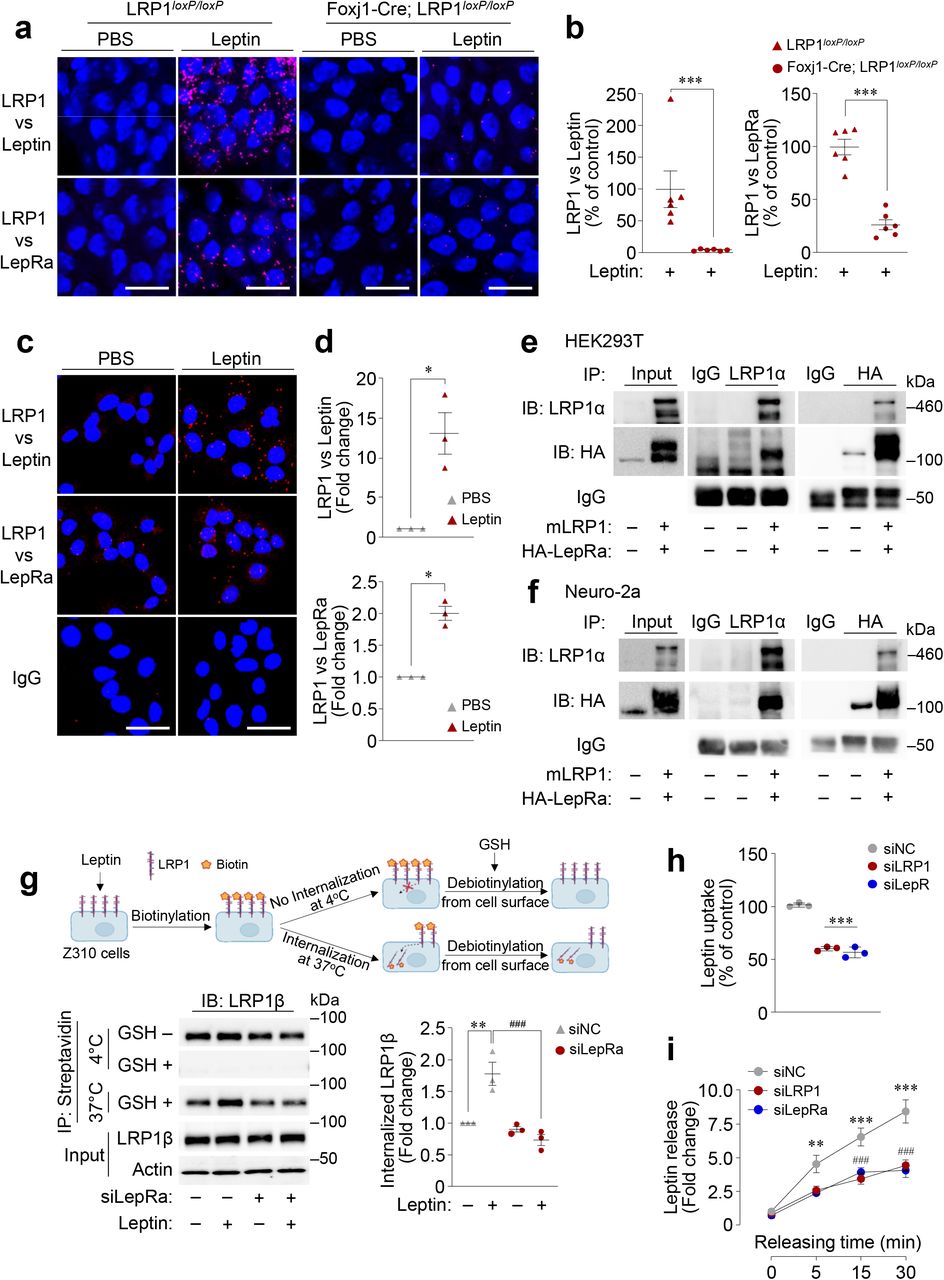
(a) Exogenous leptin physically interacts with LRP1 and induces the physical interaction of LRP1 with LepRa in epithelial cells of the ChP in vivo. LRP1 loxP/loxP and Foxj1-Cre; LRP1 loxP/loxP mice at 18 weeks of age were administered with IP leptin (1 mg/kg) and sacrificed 30 min later. The choroid plexus (ChP) samples were harvested, and proximity ligation assays (PLA) was performed. Each far-red spot represents a leptin-LRP1 or a LRP1-LepR interaction. (b) Image data for leptin-LRP1 or LRP1-LepRa interactions were quantitated by Image J (n = 5–6). Nuclei were stained with DAPI (blue). The scale bar represents 20 μm. Data are represented as means ± SEM. * P < 0.05 and ** P < 0.01 vs LRP1 loxP/loxP mice by unpaired two-sided Student’s t -test. (c) Leptin induces the physical interaction of LRP1 and LepRa in Z310 cells. Z310 cells were stimulated with or without leptin (1 μM) for 10 min. PLA was performed. Each red spot represents a leptin-LRP1 or a LRP1-LepRa interaction. (d) Image data for leptin-LRP1 or LRP1-LepRa interactions were quantitated by Image J (n = 3). N represents an individual experiment. Nuclei were stained with DAPI (blue). The scale bar represents 25 μm. Data are represented as means ± SEM. * P < 0.05 and ** P < 0.01 vs no leptin treatment by unpaired two-sided Student’s t -test. LRP1 interacts with LepR in (e) HEK 293 cells and (f) Neuro-2a cells. HEK 293 cells and Neuro-2a cells were transiently transfected with the plasmids of both pcDNA3.1(+)-C-DYK-mLRP1 (mLRP1) and pcDNA3.1(+)-N-HA-mLepRa (HA-mLepRa) for 48 h. The cell lysates (Input) were subjected to immunoprecipitation with either Normal rabbit IgG (IgG), LRP1α, or HA antibody, followed by immunoblotting with either LRP1α or HA antibody. The blots represent three independent experiments. (g) Leptin induces LRP1 internalization that is required for the LepRa. Z310 cells were transiently transfected with siNC or siRNA for LepRa (siLepRa). The cells were stimulated with or without leptin (0.5 μM) for 30 min, followed by cell surface biotinylation. The internalization of cell-surfaced receptors was induced by incubating the cells either at 4°C or 37°C, followed by debiotinylation with or without GSH buffer. The cell lysates were subjected to immunoprecipitation with streptavidin-conjugated beads. Biotinylated LRP1β (surface LRP1β and internalized LRP1β) and input LRP1β were visualized by immunoblotting (n = 3). Bars show densitometric quantitation of the internalized LRP1β (n = 3). N represents an individual experiment. Data are represented as means ± SEM. ** P < 0.01 vs no leptin in siNC, ### P < 0.001 vs leptin in siNC by two-way ANOVA. (h) Leptin uptake in choroidal plexus epithelial Z310 cells. Rat choroidal plexus epithelial Z310 cells (Z310 cells) were transiently transfected with siRNA for negative control (siNC), siRNA for LRP1 (siLRP1), or siRNA for LepRa (siLepRa). The cells were stimulated with leptin (1 μM) for 15 min, and washed 5 times with ice-cold PBS. The cells were lysed with lysis buffer. The lysates were measured with leptin levels by ELISA (n = 3). N represents an individual experiment. Data are represented as means ± SEM. *** P < 0.001 vs. siNC by one-way ANOVA. (i) Leptin release in choroidal plexus epithelial Z310 cells. Choroidal plexus epithelial cells take up and release leptin in vitro . Rat choroidal plexus epithelial Z310 cells (Z310 cells) were transiently transfected with siRNA for negative control (siNC), siRNA for LRP1 (siLRP1), or siRNA for LepRa (siLepRa). The cells were stimulated with leptin (1 μM) for 15 min, washed 5 times with ice-cold PBS and incubated with fresh leptin-free culture medium for 0, 5, 15, and 30 min. Culture medium was harvested as indicated time and leptin levels in culture medium (secreted leptin) were measured by ELISA (n = 3). N represents an individual experiment. Data are represented as means ± SEM. ** P < 0.01 and *** P < 0.001 vs. 0 min time-point in siNC, ### P < 0.001 vs 15 and 30 min time-point in siNC by two-way ANOVA.

Journal: bioRxiv

Article Title: LRP1 mediates leptin transport by coupling with the short-form leptin receptor in the choroid plexus

doi: 10.1101/2023.07.03.547520

Figure Lengend Snippet: (a) Exogenous leptin physically interacts with LRP1 and induces the physical interaction of LRP1 with LepRa in epithelial cells of the ChP in vivo. LRP1 loxP/loxP and Foxj1-Cre; LRP1 loxP/loxP mice at 18 weeks of age were administered with IP leptin (1 mg/kg) and sacrificed 30 min later. The choroid plexus (ChP) samples were harvested, and proximity ligation assays (PLA) was performed. Each far-red spot represents a leptin-LRP1 or a LRP1-LepR interaction. (b) Image data for leptin-LRP1 or LRP1-LepRa interactions were quantitated by Image J (n = 5–6). Nuclei were stained with DAPI (blue). The scale bar represents 20 μm. Data are represented as means ± SEM. * P < 0.05 and ** P < 0.01 vs LRP1 loxP/loxP mice by unpaired two-sided Student’s t -test. (c) Leptin induces the physical interaction of LRP1 and LepRa in Z310 cells. Z310 cells were stimulated with or without leptin (1 μM) for 10 min. PLA was performed. Each red spot represents a leptin-LRP1 or a LRP1-LepRa interaction. (d) Image data for leptin-LRP1 or LRP1-LepRa interactions were quantitated by Image J (n = 3). N represents an individual experiment. Nuclei were stained with DAPI (blue). The scale bar represents 25 μm. Data are represented as means ± SEM. * P < 0.05 and ** P < 0.01 vs no leptin treatment by unpaired two-sided Student’s t -test. LRP1 interacts with LepR in (e) HEK 293 cells and (f) Neuro-2a cells. HEK 293 cells and Neuro-2a cells were transiently transfected with the plasmids of both pcDNA3.1(+)-C-DYK-mLRP1 (mLRP1) and pcDNA3.1(+)-N-HA-mLepRa (HA-mLepRa) for 48 h. The cell lysates (Input) were subjected to immunoprecipitation with either Normal rabbit IgG (IgG), LRP1α, or HA antibody, followed by immunoblotting with either LRP1α or HA antibody. The blots represent three independent experiments. (g) Leptin induces LRP1 internalization that is required for the LepRa. Z310 cells were transiently transfected with siNC or siRNA for LepRa (siLepRa). The cells were stimulated with or without leptin (0.5 μM) for 30 min, followed by cell surface biotinylation. The internalization of cell-surfaced receptors was induced by incubating the cells either at 4°C or 37°C, followed by debiotinylation with or without GSH buffer. The cell lysates were subjected to immunoprecipitation with streptavidin-conjugated beads. Biotinylated LRP1β (surface LRP1β and internalized LRP1β) and input LRP1β were visualized by immunoblotting (n = 3). Bars show densitometric quantitation of the internalized LRP1β (n = 3). N represents an individual experiment. Data are represented as means ± SEM. ** P < 0.01 vs no leptin in siNC, ### P < 0.001 vs leptin in siNC by two-way ANOVA. (h) Leptin uptake in choroidal plexus epithelial Z310 cells. Rat choroidal plexus epithelial Z310 cells (Z310 cells) were transiently transfected with siRNA for negative control (siNC), siRNA for LRP1 (siLRP1), or siRNA for LepRa (siLepRa). The cells were stimulated with leptin (1 μM) for 15 min, and washed 5 times with ice-cold PBS. The cells were lysed with lysis buffer. The lysates were measured with leptin levels by ELISA (n = 3). N represents an individual experiment. Data are represented as means ± SEM. *** P < 0.001 vs. siNC by one-way ANOVA. (i) Leptin release in choroidal plexus epithelial Z310 cells. Choroidal plexus epithelial cells take up and release leptin in vitro . Rat choroidal plexus epithelial Z310 cells (Z310 cells) were transiently transfected with siRNA for negative control (siNC), siRNA for LRP1 (siLRP1), or siRNA for LepRa (siLepRa). The cells were stimulated with leptin (1 μM) for 15 min, washed 5 times with ice-cold PBS and incubated with fresh leptin-free culture medium for 0, 5, 15, and 30 min. Culture medium was harvested as indicated time and leptin levels in culture medium (secreted leptin) were measured by ELISA (n = 3). N represents an individual experiment. Data are represented as means ± SEM. ** P < 0.01 and *** P < 0.001 vs. 0 min time-point in siNC, ### P < 0.001 vs 15 and 30 min time-point in siNC by two-way ANOVA.

Article Snippet: Cells were incubated with primary antibodies against leptin (Cat#: PA5-47023, Thermo Fisher Scientific), LRP1 (Cat#: 37-3800, Thermo Fisher Scientific), or leptin receptor (Cat#: PA1-053, Thermo Fisher Scientific) overnight at 4°C.

Techniques: In Vivo, Ligation, Staining, Transfection, Immunoprecipitation, Western Blot, Quantitation Assay, Negative Control, Lysis, Enzyme-linked Immunosorbent Assay, In Vitro, Incubation

Leptin induces the physical interaction of LRP1 and LepR in epithelial cells of the choroid plexus in vivo . LRP1 loxP/loxP and Foxj1-Cre; LRP1 loxP/loxP mice at 18 weeks of age were administered with IP leptin (1 mg/kg) and sacrificed 30 min later. The choroid plexus samples were harvested, and proximity ligation assays was performed with both normal rabbit IgG and normal mouse IgG. The scale bar represents 20 μm.

Journal: bioRxiv

Article Title: LRP1 mediates leptin transport by coupling with the short-form leptin receptor in the choroid plexus

doi: 10.1101/2023.07.03.547520

Figure Lengend Snippet: Leptin induces the physical interaction of LRP1 and LepR in epithelial cells of the choroid plexus in vivo . LRP1 loxP/loxP and Foxj1-Cre; LRP1 loxP/loxP mice at 18 weeks of age were administered with IP leptin (1 mg/kg) and sacrificed 30 min later. The choroid plexus samples were harvested, and proximity ligation assays was performed with both normal rabbit IgG and normal mouse IgG. The scale bar represents 20 μm.

Article Snippet: Cells were incubated with primary antibodies against leptin (Cat#: PA5-47023, Thermo Fisher Scientific), LRP1 (Cat#: 37-3800, Thermo Fisher Scientific), or leptin receptor (Cat#: PA1-053, Thermo Fisher Scientific) overnight at 4°C.

Techniques: In Vivo, Ligation